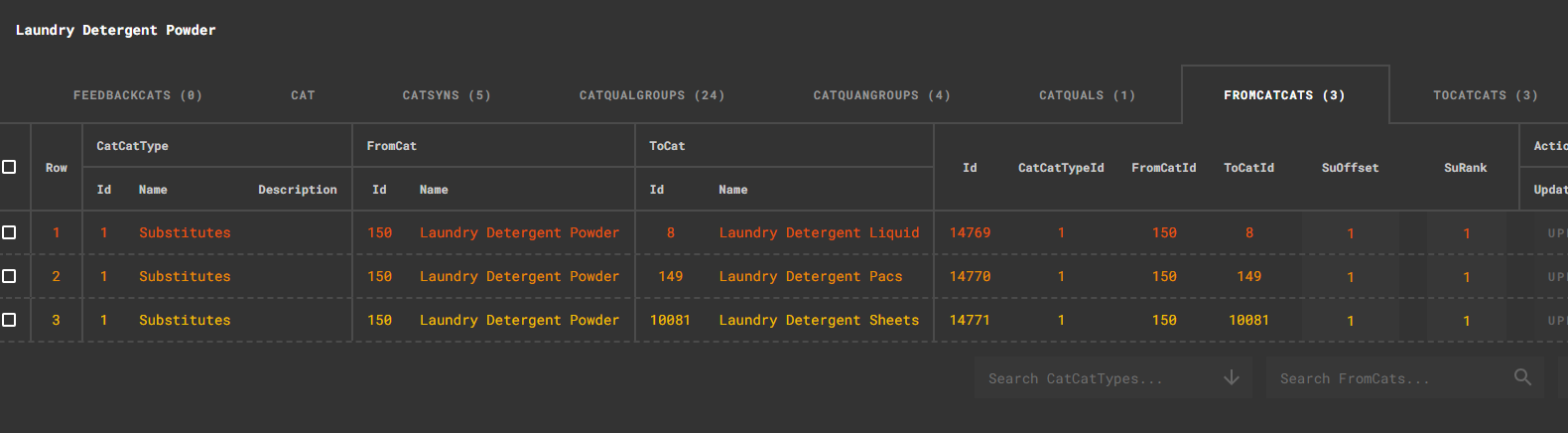
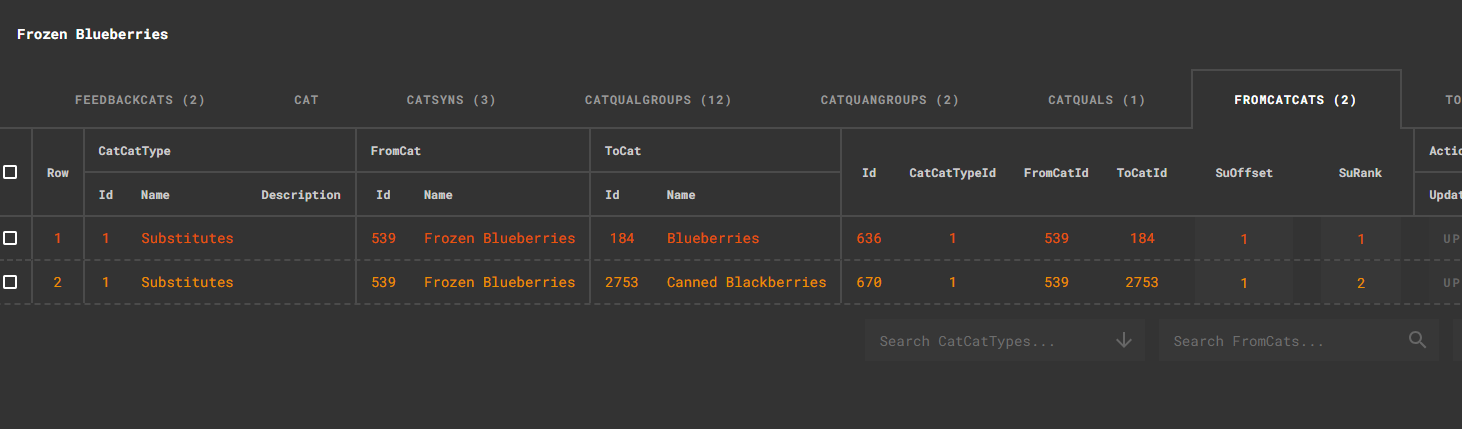
A Category-To-Category represents a connection between a "from" Category and a "to" Category.
A Category-To-Category represents a connection between a "from" Category and a "to" Category for substitution purposes—used when products do not belong in the same Category (due to differences in product type, form, unit, etc.) but can still reasonably serve as substitutes for each other.
This structure enables substitution logic across distinct Categories without merging them, preserving clarity while supporting flexibility in shopper experiences.
Out-of-Stock Events Become Dead Ends
When a product is unavailable and there is no Category-to-Category map, the shopper sees 'unavailable' and leaves. A structured substitution map turns every OOS event into a recovery opportunity.
Cross-Category Recommendations Have No Foundation
Without explicit category relationships, recommendation engines rely on co-purchase signals alone — which require historical data that new categories and new products don't have.
Substitution Quality Degrades at Scale
Manual substitution rules don't scale. As the catalog grows, unmapped categories accumulate. Category-to-Category provides a structured, maintained alternative to brittle rule tables.
How Category-to-Category Works
Browse structures are built bottom-up, starting from specific categories and rolling into higher-level groupings:
01
Bidirectional Substitution Relationships
Every Category-to-Category relationship is bidirectional and weighted. 'Coffee K-Cups' and 'Coffee Pods' are mutual substitutes — and the substitution strength is scored, not binary.
02
Powers the Substitutes API
The Substitutes API draws from Category-to-Category maps to build its substitution logic. Without this layer, substitution quality degrades to co-purchase guessing.
03
Cross-Department Mapping
Category-to-Category is not limited to same-parent categories. A cross-department substitution — like Plant-Based Milk for Dairy Milk — is an explicit, maintained relationship.
Category-to-Category Examples
Ready to map every substitution relationship?
See how Category-to-Category turns every out-of-stock event into a structured recovery opportunity.