
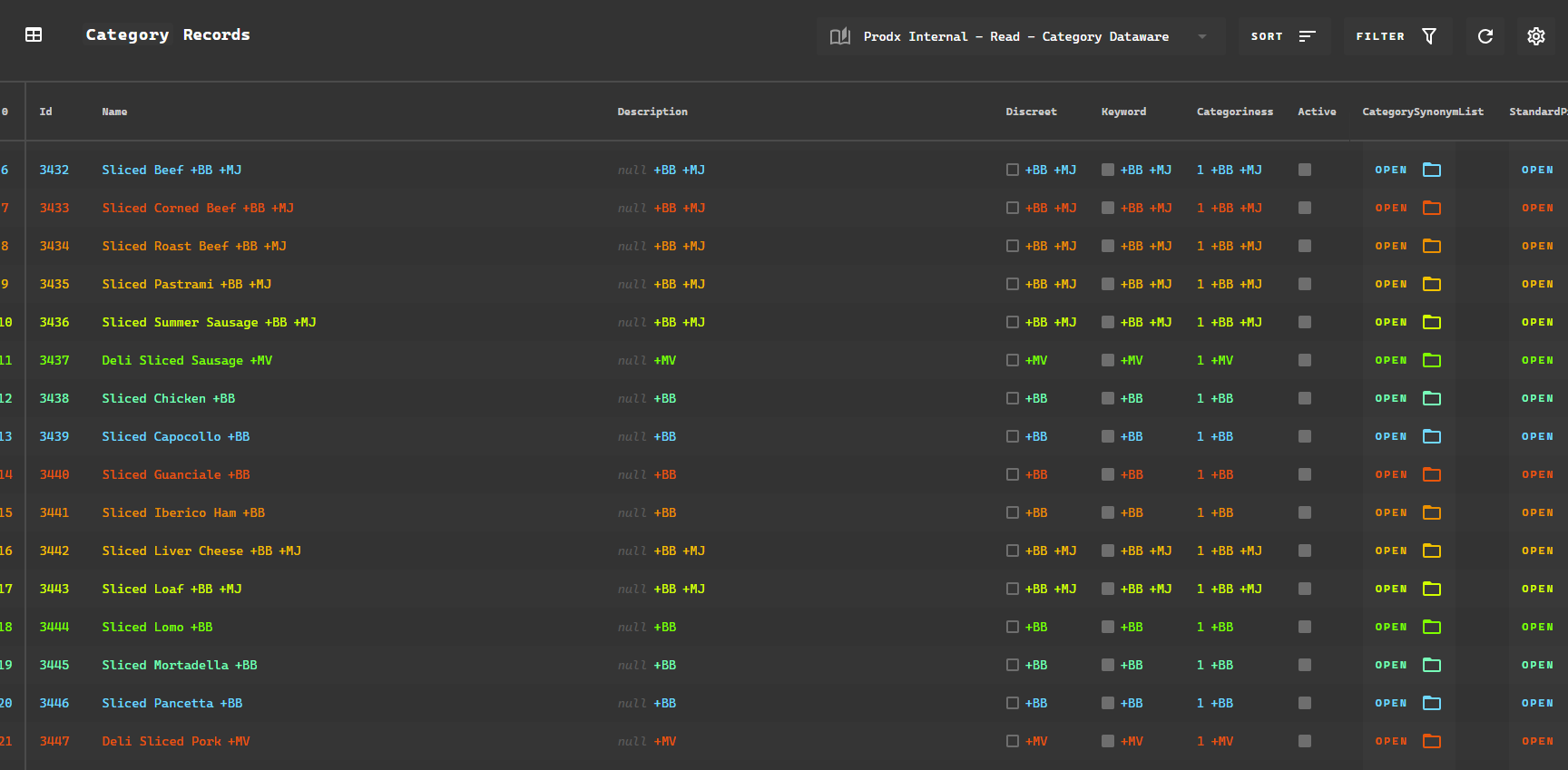
Category

The precise leaf
that places every
product exactly
where it belongs.

Category is the most granular level of the Prodx taxonomy — the specific node where a product lives. It is the foundation everything else builds on: Browse hierarchies, substitution logic, search ranking, and navigation all depend on clean, accurate Category assignment.

Why Category Precision Matters

Vague or incorrect category assignments corrupt every downstream system that depends on them.

Miscategorized Products Poison the Hierarchy

A product assigned to the wrong Category contaminates every parent Browse node. It shows up in wrong navigation trees, skews department analytics, and surfaces in irrelevant search results.

Inconsistent Naming Breaks Aggregation

When the same product type appears under 'K-Cups', 'Coffee Pods', and 'Single Serve Coffee' without canonical resolution, roll-up analytics become meaningless and substitution logic breaks.

Search Cannot Rank by Category Depth

Without precise category assignment, search engines cannot apply category-level ranking signals. All products in a department surface equally, regardless of how well they match the shopper's intent.

How Category Works

A canonical, maintained set of leaf-level product categories that anchor the entire Prodx taxonomy.
To determine what a Category is for a particular product, ask the following questions:
01
What is it?
The answer is the Category.
02
What products are substitutes?
This helps determine whether the products should belong in the same Category or in different ones. If products serve the same purpose and can be swapped for one another, they likely belong in the same Category. If they are distinct but still substitutable, they may belong in separate Categories with a CategoryCategory connection linking them as related alternatives.
03
What is the use of the product?
If the use case is the same, then they are substitutable. If they have different use cases, then they are not substitutable and should be in different Categories.
04
Are the products distinct?
If the products are distinct, they should be in the same Category. If they are not distinct, they should be under different Categories or under multiple Categories.
05
What products does it share attributes with?
Do all the products have the same form (powder vs. liquid vs. pill)? If the products have different forms, then they also have different use cases and should be in different Categories. If they can be substituted for each other, then there can be a CategoryCategory.
06
What products does it share units with?
Sometimes the units are the same but the use case is different, and sometimes the units are different even though the use case is the same, so this question should only be considered after answering all the above questions.
Example: Sunscreen Spray vs. Sunscreen Lotion. Different use cases, but both of them use Ounces and Fluid Ounces as units.
Category Examples
Example 1: Oscar Mayer Deli Fresh Oven Roasted Turkey Breast

What is it?
Sliced turkey.

What products are substitutes?
Other sliced turkey meats. Not sliced ham or sliced bologna or sliced chicken. The combination packs that contain sliced turkey would also be substitutes.

What is the use of the product?
Lunch meat. So even though there are other lunch meats, they should be in their own Categories because of the answers to the above questions.

Is the product distinct?
Yes. The products are either turkey or chicken or bologna. Even if the bologna is turkey bologna, when you ask question 1, "what is it?", the answer is bologna, not turkey.

The above questions and answers have determined that Sliced Turkey should be its own Category, with CategoryCategory link to Sliced Meat Variety Pack. The other sliced turkeys will be the first substitutes, followed by the variety packs.

Example 2: Almond Breeze Almond Cashew Milk

What is it?
Almond & cashew milk.

What products are substitutes?
Other almond & cashew milks, as well as other almond milks, other cashew milks, and even other non-dairy milks.

What is the use of the product?
Used for drinking and cooking. Same use as the other non-dairy milks, but the above questions determine that it should be its own Category.

Are the products distinct?
Yes. There are a few blends (almond & cashew, cashew & coconut, almond & walnut, etc.), but they are distinct. And the almond, coconut, hemp, etc. milks are also very distinct.

What products does it share attributes with?
 Shares similar attributes with all other non-dairy milks.

What products does it share units with?
 Shares similar units with all other non-dairy milks.

The above questions and answers have determined that Almond and Cashew Milk should be its own Category, with CategoryCategory links to Almond Milk and Cashew Milk first, then links to the other Non-Dairy Milks. The other almond cashew milks will be the first substitutes, followed by almond milks and cashew milks, then followed with all the other non-dairy milks.

How Category Works

A canonical, maintained set of leaf-level product categories that anchor the entire Prodx taxonomy.
01
Canonical Leaf-Level Assignment
Every product is assigned to exactly one Category. That Category is the single source of truth for the product's position in the taxonomy — no duplicates, no ambiguity.
02
Powers Every Upstream Layer
Category feeds Browse, Path, Substitution, and Search. Clean Category data is the prerequisite for every other Prodx capability to function correctly.
03
Retailer-Specific Overrides
Global canonical Categories can be supplemented with retailer-specific extensions. A retailer's private-label category structure maps cleanly to the Prodx canonical set.
Browse Path Examples (starting at lowest level)

Ready to anchor your taxonomy?

See how Prodx Category gives every product a precise, canonical leaf-level home in your catalog.
© 2026 Prodx. All rights reserved.