A Unit is the measurement label used as part of a Quantity (quantitative attribute). It defines what is being measured—such as volume, weight, count, or packaging format.
Without a defined set of canonical units, measurement data diverges across sources and becomes incomparable.
Non-Standard Units Fragment the Data
Supplier feeds use 'oz', 'OZ', 'Oz', 'ounce', and 'ounces' interchangeably. Without a canonical unit registry, normalization logic handles five cases instead of one.
Cross-Unit Comparison Requires a Shared Base
Comparing a 355 ml can to a 12 fl oz can requires knowing that both units convert to the same base. Without a canonical unit definition, that conversion is ambiguous or system-specific.
New Units Have No Canonical Home
When a supplier introduces a new unit format, there is no canonical home for it. It either breaks the normalization pipeline or is silently dropped — creating invisible data gaps.
How Unit Works
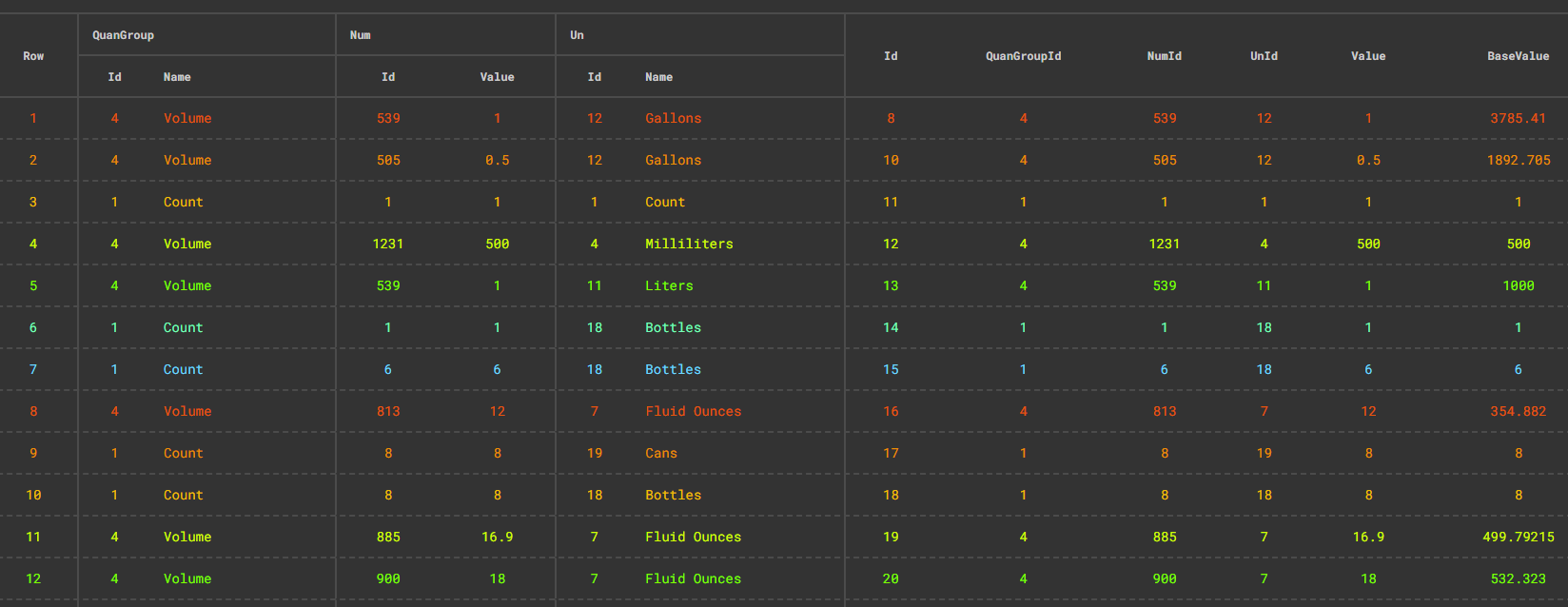
Units are grouped into QuantityTypes (e.g., Volume, Count, Weight) to support standardized comparisons, substitutions, and unit-based pricing.
01
Canonical Unit Registry
Unit defines every measurement term used in the Prodx taxonomy — its canonical abbreviation, its full name, its physical dimension, and its conversion factor to the base unit.
02
Powers Normalization
Every Quantity value references a canonical Unit. Normalization to a base unit is exact and lossless because the conversion factor is defined at the Unit level, not hardcoded in application logic.
03
Dimension-Scoped Units
Units are scoped to their physical dimension — Weight, Volume, Count, Length. A Volume unit cannot be applied to a Weight Quantity Type. The schema enforces dimensional consistency.
Examples of Units
Ready to define your measurement vocabulary?
See how Prodx Unit gives every measurement term a canonical home — and makes normalization exact.