Quality-To-Quality

Quality-to-Quality defines which attribute values are acceptable substitutes for each other.

A Quality-to-Quality is a connection between two Qualities, where one acts as the parent and the other as the child. This relationship allows a child Quality to inherit keywords and substitution logic from its parent, improving searchability, product grouping, and recommendation accuracy.

Why Quality-to-Quality Mapping Matters

A Quality-to-Quality (qualitative attribute connected to a qualitative attribute) is a parent Quality (qualitative attribute) connected to a child Quality. This allows the Quality to have a base for substitution and keyword purposes.

Attribute-Blind Substitution Fails Shoppers

A shopper who chose 'Decaf' specifically does not want 'Regular' as a substitute. Without Quality-to-Quality mapping, substitution engines ignore this — and the shopper rejects the substitute.

Certification Attributes Cannot Self-Substitute

'Organic' is a binary attribute. Without an explicit Quality-to-Quality rule, no substitution engine knows whether 'Conventional' is acceptable when 'Organic' is unavailable — the answer depends on the retailer's policy.

Graded Attributes Need Proximity Logic

'Dark Roast' to 'Medium-Dark Roast' is a small step. 'Dark Roast' to 'Light Roast' is a large one. Without a structured proximity map, substitution has no way to score this distance.

How Quality-to-Quality Works

A maintained, weighted map of attribute value relationships that governs substitution precision.
01
Weighted Attribute Proximity
Quality-to-Quality relationships carry a proximity weight. 'Dark Roast' to 'Medium-Dark Roast' scores 0.88. 'Dark Roast' to 'Light Roast' scores 0.31. Substitution engines use this weight to rank alternatives.
02
Binary vs Graded Attribute Handling
Binary attributes like 'Organic' have strict Quality-to-Quality rules — either it matches or it doesn't. Graded attributes like 'Fat Content' use proximity scoring across a range.
03
Retailer-Configurable Rules
Retailers can configure their own Quality-to-Quality policies on top of the canonical Prodx map. A retailer may decide 'Organic' never substitutes to 'Conventional' — that rule is configurable.
Use Case Examples: Keyword Inheritance & Grouping
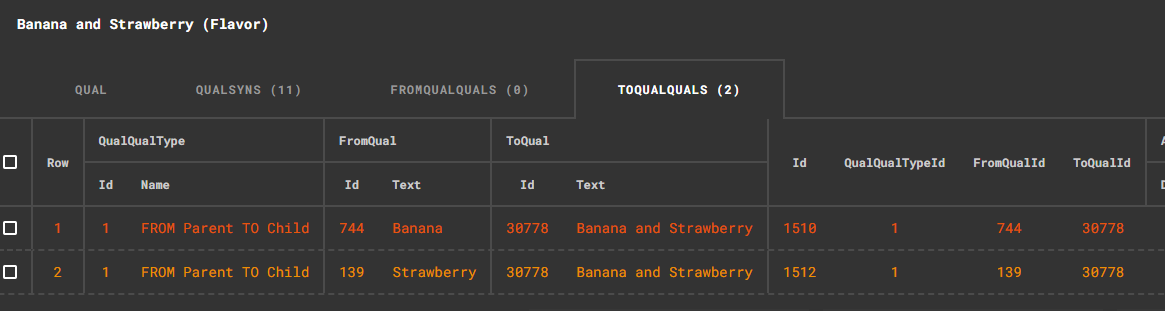
Example 1 - Flavor:
This enables products with "Banana and Strawberry" flavor to appear in searches for either flavor, and to be grouped alongside single-flavor products for better substitution.
Example 2 - Cut Type:
This allows "Diced Tomatoes" and "Chopped Tomatoes" to be sorted together as substitutes and to inherit the broader keyword "Cut".
Example 3 - Whiskey Variety:
This connects all relevant products under a shared, searchable attribute while maintaining their unique identity.

Ready to make substitution attribute-aware?

See how Quality-to-Quality mapping ensures every substitute respects the shopper's attribute preferences.
© 2026 Prodx. All rights reserved.