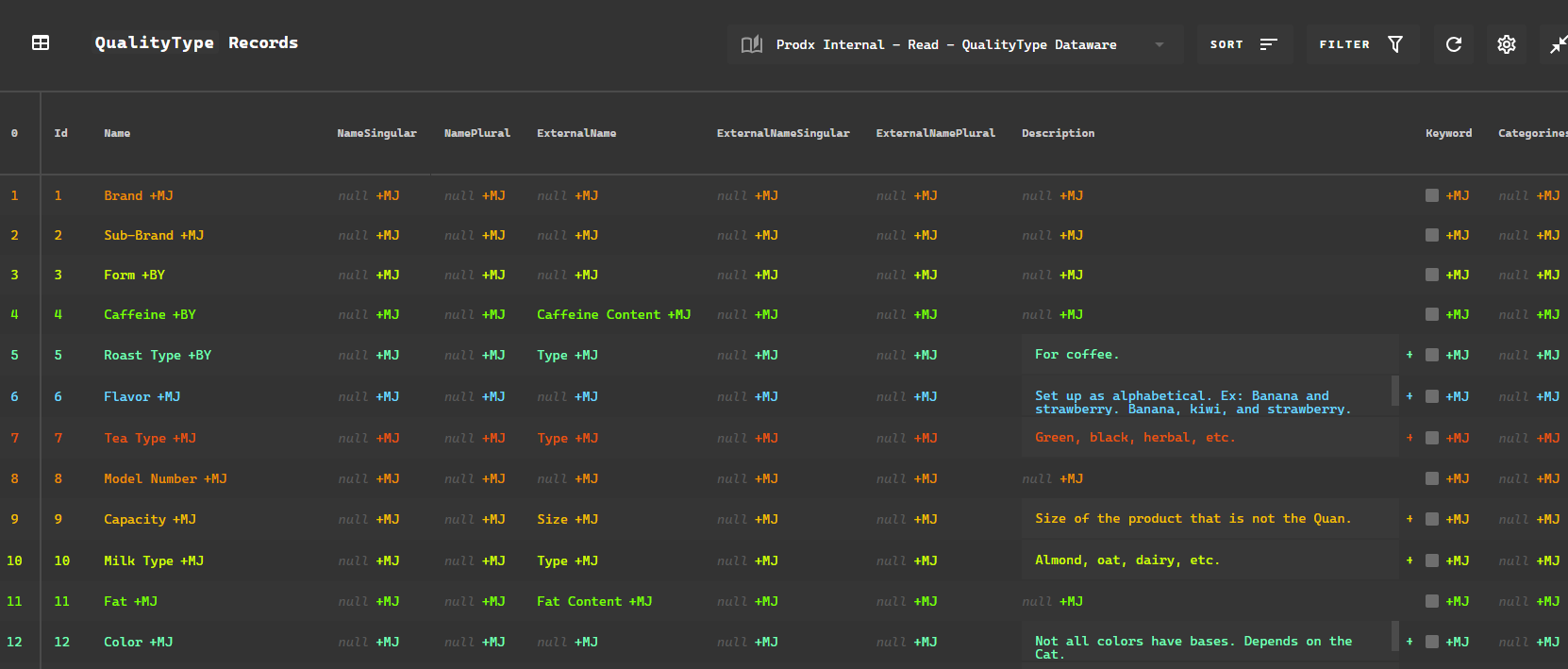
Each QualityType represents a specific dimension of comparison or distinction—helping organize how products are enriched, filtered, or personalized across a category.
Unstructured Attributes Cannot Power Filters
When product attributes are stored as free text, shoppers cannot filter by them. A shopper looking for 'low fat' has no structured attribute type to filter on — so the filter does not exist.
Substitution Cannot Match on Attributes
Without typed quality dimensions, substitution engines cannot match 'Organic' products to other 'Organic' products. The attribute exists in the data, but has no structure to query against.
Attribute Coverage Gaps Are Invisible
When quality types are not defined, you cannot identify which products are missing key attributes. Coverage gaps are invisible until they surface as shopper complaints.
How Quality Type Works
QualityTypes can be Text, Boolean, or Numeric in format. Each QualityType contains a controlled set of standardized values (called Qualities) that can be attached to products during attribution.
01
Define Attribute Dimensions
Quality Type defines the class of an attribute — its data type (boolean, enum, range, string), its scope (which categories it applies to), and how it participates in filtering and matching.
02
Powers Attribute-Driven Filtering
Every Quality Type becomes a filterable dimension in browse and search experiences. Shoppers can filter by Organic, Fat Content, Roast Type, and more — because the data is typed, not free text.
03
Informs Substitution Matching
Quality Types tell the Substitutes API which attributes must match in a substitution. 'Organic' is a binary match. 'Fat Content' is a range match. The type governs the logic.
Quality Type Examples
Ready to structure your product attributes?
See how Quality Types make every product characteristic queryable, filterable, and substitution-ready.