
Prodx · Grocery eCommerce Intelligence · 2026
The Product Detail Page Problem
Grocery eCommerce has spent a decade optimizing the path to the product page. Almost no one has optimized what happens on it. The result is a revenue gap that doesn’t show up in standard analytics — and doesn’t get fixed until someone goes looking for it.
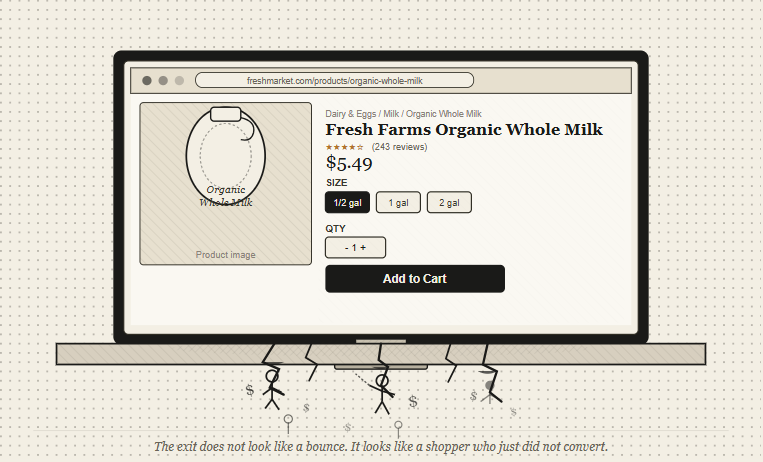
1 in 10 shoppers arrives at a product page wanting a different size, flavor, or form — and leaves to search again. That exit doesn’t look like a bounce. It looks like a shopper who just didn’t convert. Most analytics stacks can’t tell the difference. Most retailers never ask.
The modern grocery product page was designed to answer one question: is this the right product? It was not designed to answer the follow-up: if not this exact item, what about a different size, flavor, or form of the same product?
When a shopper lands on a 32oz bottle of dish soap and wants the 16oz, they have two options: start their search over, or leave. Neither outcome serves the retailer. The shopper who starts over might find it — or might not, or might abandon the session entirely. The shopper who leaves is already gone. In both cases, the product page failed at its most basic job.
“The variant exit is the most common conversion failure in grocery eCommerce. It’s also the most invisible.”
Standard eCommerce analytics measure sessions, page views, and add-to-cart events. They don’t measure the intent that never converted because the right variant wasn’t surfaced. That gap — between what the shopper wanted and what the page offered — is where grocery retailers are quietly losing revenue at scale.
The problem isn’t shopper behavior. Shoppers are doing exactly what they’re supposed to do: looking for the product they want. The problem is that most grocery PDPs treat every SKU as an island, with no visible connection to the other sizes, flavors, and forms that the same shopper might buy instead.
Prodx has deployed variant connectivity across top-15 US grocery operators — retailers with mature eCommerce platforms, established catalog infrastructure, and no shortage of prior optimization efforts. The pattern is consistent: when shoppers can navigate between variants on the PDP without returning to search, the behavior change is immediate and measurable.
| Metric | Result |
|---|---|
| Product Interactions | 2×+ — Shoppers engaging with product pages at more than double the prior rate once variant navigation is present |
| Cart Additions | 2×+ — Add-to-cart events more than doubled across the same product catalog, same traffic, no additional ad spend |
| Add-to-Cart Conversion | +16 pts — Conversion rate increase across participating PDPs, from the mid-30s to the high-40s |
| Average Order Value | ↑ $1.40 — Shoppers who navigate variants add 1–2 more items per session, AOV lift that compounds at scale |
Data reflects outcomes across top-15 US grocery operators. Figures represent directional patterns across deployments; individual results vary by catalog size, traffic volume, and platform configuration.
The mechanism is straightforward: a shopper who finds the variant they want without leaving the page doesn’t just convert at a higher rate — they tend to add more to their cart. Variant discovery and basket size are connected behaviors. Retailers optimizing for one get the other.
The revenue implication scales directly with catalog size and traffic volume. For a grocer running 30,000+ eCommerce SKUs across a meaningful digital footprint, the compounding effect of variant connectivity across every eligible PDP is significant — and it accrues from existing traffic, not incremental acquisition.
The variant connectivity problem is well understood by most eCommerce teams. The reason it persists isn’t awareness — it’s infrastructure. Connecting every size, flavor, and form of a product on the PDP requires the underlying product data to be complete, accurate, and consistently structured across the entire catalog. In most grocery environments, it isn’t.
New Items — Every new SKU needs to be variant-mapped at onboarding
New items enter the catalog continuously — private label launches, seasonal additions, new vendor onboarding. Each one needs accurate attributes and variant relationships established from day one, not retroactively.
Private Brand — Own-brand SKUs are the highest-complexity variant problem
Private label lines often span the widest range of sizes, flavors, and forms — and have the least standardized attribute data. They’re also where variant connectivity has the highest impact on margin.
Item Changes — Reformulations, repackaging, and discontinuations break variant graphs
A packaging refresh changes attributes. A reformulation changes ingredient flags. A discontinued variant creates a dead-end in the navigation. Without continuous data governance, the variant graph degrades faster than it was built.
Perpetual Updates — Static data infrastructure can’t sustain dynamic variant connectivity
A grocery catalog changes constantly. Variant connectivity that requires manual maintenance doesn’t scale — it becomes a bottleneck that limits which categories can benefit, and how quickly new items can participate.
The retailers getting this right aren’t the ones who built a better front-end. They’re the ones who resolved the data infrastructure problem first — and found that the front-end improvement followed almost automatically.
Prodx has fully standardized product data infrastructure operating across top-15 US grocers — the same foundation that makes variant connectivity possible at catalog scale. For retailers whose product data is already in the Prodx system, activation is fast. For retailers evaluating where the infrastructure investment lands first, the PDP is the answer.
Send us your product feed. We’ll show you what variant connectivity looks like across your catalog — and what it’s worth.
Get in touch · hello@prodx.com · prodx.com
Prodx · The data infrastructure everything runs on. © 2026 Prodx · Grocery eCommerce Intelligence